
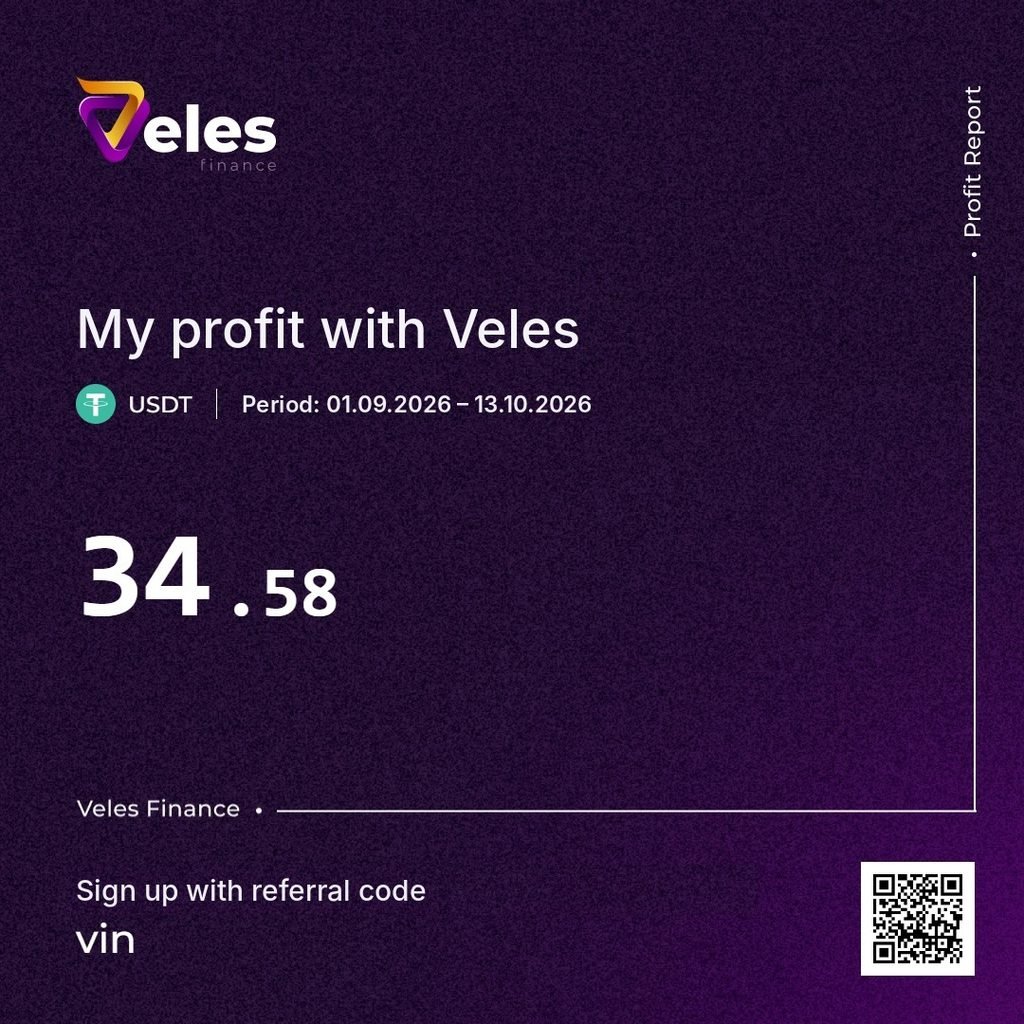
In short: Veles Finance is a cloud platform for crypto trading bots. It connects to your exchange via API and trades by your rules around the clock. Your funds stay on the exchange, and Veles charges 20% of profitable trades only, capped at $50 a month. I have used Veles for about two years, and since September 2026 it has run my company’s bots on Binance. Over six weeks, from 1 September to 13 October, they earned 34.58 USDT with no losing day.
Updated: October 2026.
Affiliate link — I may earn a reward if you sign up.
What is Veles Finance?
Veles is an automated crypto trading service. You connect your exchange account with an API key, set up a bot or pick a ready-made strategy, test it on historical data and launch it. From then on, the bot opens and closes trades by your rules.
What the platform offers in 2026:
- DCA bots that average into a position and can use entry signals.
- Backtesting to test a strategy on historical data before risking real money.
- A trading terminal for manual trading on several exchanges from one screen.
- A strategy marketplace with ready-made bots you can copy and adjust.
- Mobile apps for iOS and Android to monitor bots and get alerts.
- Veles Broker for trading without API keys through a brokerage account.
Supported exchanges include Binance, Bybit, OKX, Gate, HTX, BingX, Bitget and Hyperliquid; availability depends on your region. Veles reports over 100,000 traders and more than 70 million completed trades.
Security: your money stays on the exchange
Veles never holds your funds. Bots work through an API key with trading rights but no withdrawal rights. Even if someone got into your Veles account, they could not move money off your exchange through it.
When I create a key, I always do three things: disable withdrawals, add an IP whitelist where the exchange supports it, and turn on two-factor authentication on the exchange.
How much does Veles cost?
| Item | Price |
|---|---|
| Bots, terminal, basic backtests | free |
| Service fee | 20% of profit on closed winning trades |
| Fee cap | $50 per month per trading type |
| Advanced backtests | separate PRO plans |
| Exchange trading fees | paid to the exchange separately |
The nice part: a losing month costs you nothing. The fee is taken from an internal Veles balance, so you need to top it up. I fund it from the company’s Binance account and keep the receipts as business expenses.
My strategy: a ladder of limit orders
All my bots are spot longs, no leverage. The logic is the same for each:
- The bot buys with a small first order of about 9 USDC.
- Below it sits a ladder of 20 limit orders. Each one is slightly larger and lower than the last; the bottom step is about 40% below the first buy.
- If the price drops, the bot buys more and the average entry price goes down.
- Once the price is about 3% above the average, a trailing stop sells the whole position and the cycle starts again.
All pairs trade against USDC on Binance. Six bots are running on roughly €400 of working capital. The goal is to grow it to €5,000 and keep no more than 30% of it in trades at once.
Five real trades
These are trades from 8 September to 13 October 2026, as Veles shows them. The interesting part is not the profit but how the bot rode out the dips.
| Pair | Orders filled | Position, USDC | Drop from first buy | Time in trade | Profit, USDC |
|---|---|---|---|---|---|
| ICP/USDC | 11 of 20 | 128.83 | −18.5% | 9.5 days | 3.82 (2.96%) |
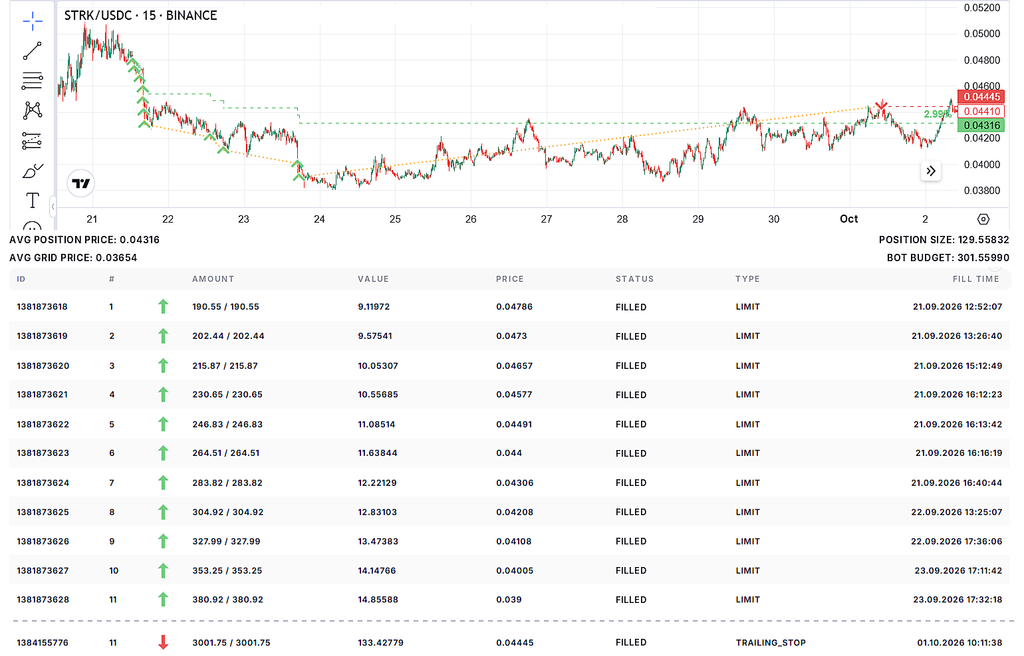
| STRK/USDC | 11 of 20 | 129.56 | −18.5% | 9.9 days | 3.87 (2.99%) |
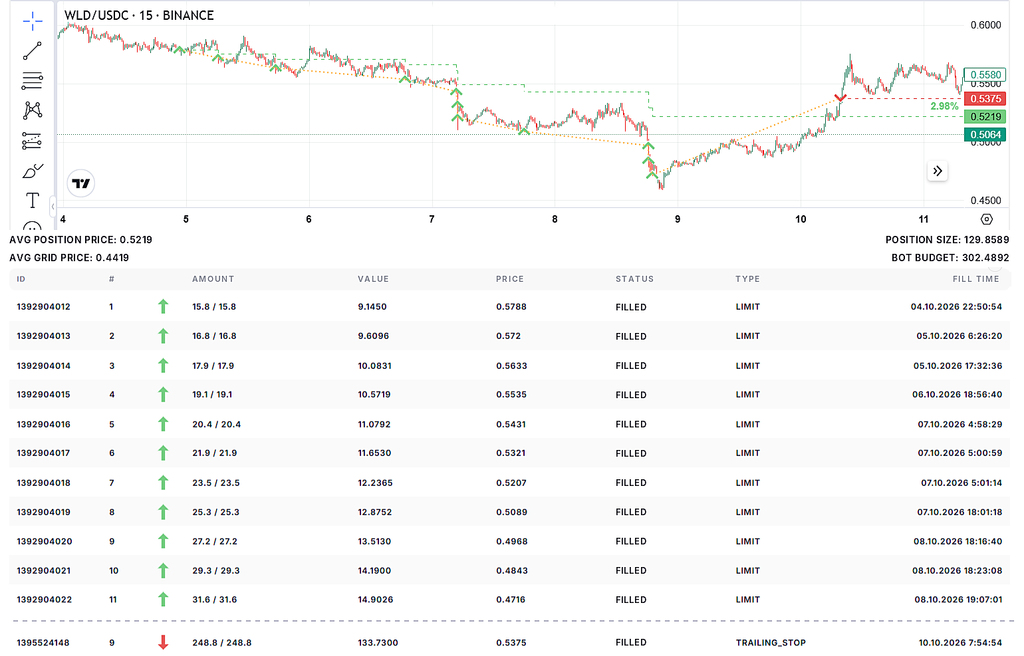
| WLD/USDC | 11 of 20 | 129.86 | −18.5% | 5.4 days | 3.87 (2.98%) |
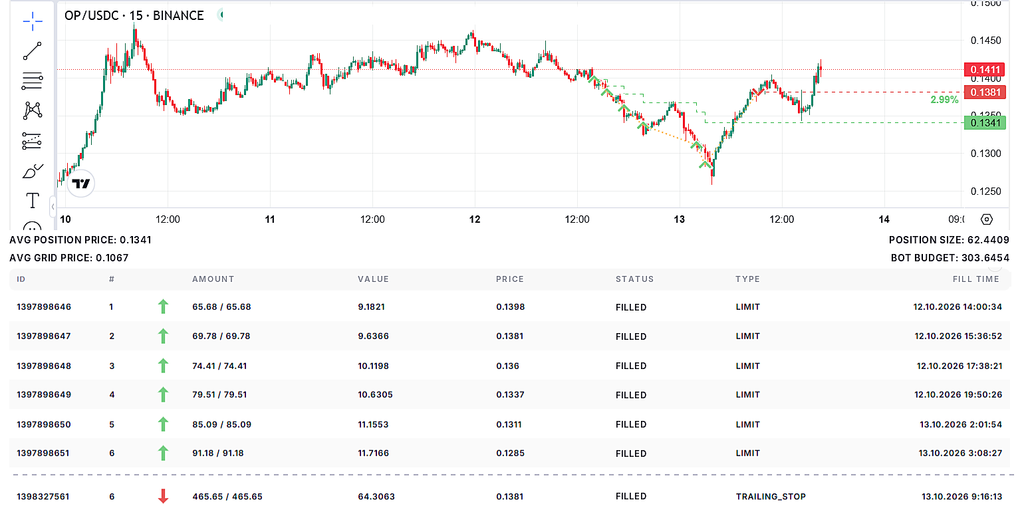
| OP/USDC | 6 of 20 | 62.44 | −8.1% | 19 hours | 1.87 (2.99%) |
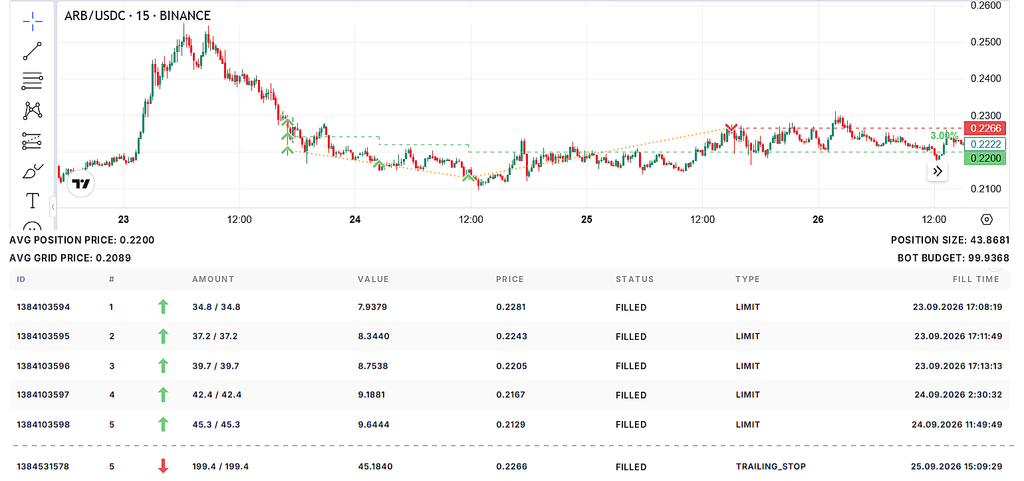
| ARB/USDC | 5 of 10 | 43.87 | −6.7% | 1.9 days | 1.32 (3.00%) |
Together these five trades made 14.74 USDC.
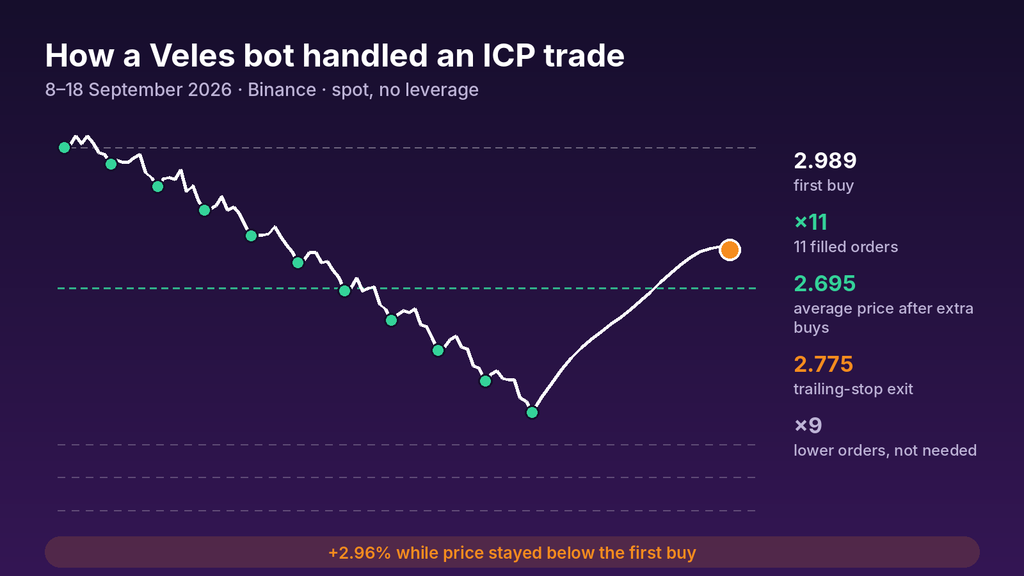
ICP tells the story best. The first buy was on 8 September at 2.989. ICP then fell for over a week, down to 2.435. The bot filled 11 orders and pulled the average price down to 2.695. On 18 September the price bounced, and the trailing stop sold everything at 2.775. The coin never got back to the first buy price, yet the trade closed in profit.
STRK and WLD followed the same script: an 18.5% dip, 11 ladder steps, an exit on the bounce. STRK stayed open for almost 10 days, which is normal for this strategy.
OP and ARB were quick: a shallow dip, 5–6 extra buys and an exit in under two days.
Six-week results
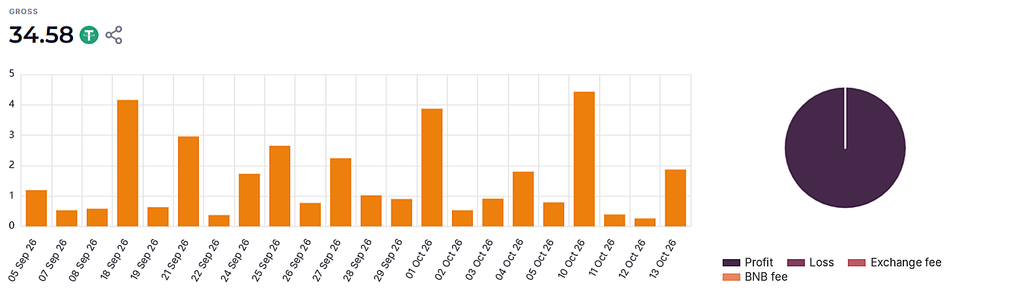
From 1 September to 13 October 2026, the bots closed trades on 22 of 43 days, and every one of those days was profitable. The best days were 10 October (about 4.4 USDT) and 18 September (about 4.2 USDT). The total is 34.58 USDT before the Veles fee; after the 20% fee, about 27.7 USDT remains.
On roughly €400 of capital, that is around 7–8% in six weeks. But the market in this period dipped and bounced, which suits this strategy. A long crash would look very different.
What two years on Veles taught me
From January 2024 to August 2026, I traded through Veles on a personal Bybit account with up to about €1,000. Profit over that time: 1,519.56 USDT. My record day: $40.
The main lesson: more bots does not mean more money. In late 2024 I ran about 230 bots on nearly every coin, $20 each. Only around 15 of them traded on a normal day. When the market dropped hard, almost all fired at once and there was not enough capital for all of them. Hence my rule today: keep spare capital and no more than 30% in trades.
My second rule: I don’t sell positions at a loss. If bots run out of budget in a dip, I top up the balance and wait for the bounce. That only works with money you won’t need for months.
Pros and cons
Pros
- You pay only on profit, with a $50 monthly cap.
- Funds never leave the exchange; withdrawals via API are impossible.
- Backtests help weed out bad settings before launch.
- Works with the major exchanges and has mobile apps.
- A bot doesn’t panic or abandon the plan in a dip.
Cons and risks
- A long ladder struggles in a prolonged bear market: positions can stay open for months.
- You need spare capital, or the bots can’t fill the lower steps.
- Good backtests don’t guarantee future profit.
- No business accounts: for my company I opened a separate Veles account on the company email.
Who is Veles for?
- Traders already on Binance, Bybit or OKX who want to take emotion out of trading.
- People willing to spend time on setup and backtests rather than looking for a money button.
- Anyone with capital they can leave untouched for a long time.
It is not for anyone expecting quick results or trading money they can’t afford to lose.
Veles referral programme
Veles pays partners up to 30% of the platform fee earned from referred users. For site owners and trading creators it is a clear source of passive income, as long as it is presented honestly: show real trades, including the boring ones, and never promise easy money.
Disclosure: links to Veles in this article are referral links. If you sign up through them, I receive part of the service fee at no extra cost to you.
FAQ
Can Veles withdraw my money? No. Bots use an API key without withdrawal rights, and your funds stay on your exchange.
How much do I need to start? Technically a few tens of dollars per bot. A 20-order ladder like mine needs a budget of about 300 USDC per bot.
Do I need to watch the bots? Not constantly. Once a week I check which bots are stuck in a dip and whether there is enough capital.
Does Veles guarantee profit? No. All trading carries the risk of losing part or all of your capital.
Verdict
For me, Veles is a working tool, not a promise of income. Over six weeks my company’s bots ended every trading day in profit, but the real test of the strategy is a long crash. I’ll publish monthly results so you can see the good and the bad periods.
Affiliate link — I may earn a reward if you sign up.
This article is not investment advice. Crypto trading carries a high level of risk.
Sources: Veles Finance — official website (pricing, exchanges, security)