In short
I have used FaucetPay since February 2022: 67 deposits and 35 withdrawals, and every withdrawal arrived. It is a working microwallet for small crypto payouts from faucets, PTC sites and offerwalls. Use it as a transit point: collect, then withdraw to an exchange or your own wallet. I don’t recommend storing money there, playing its games or chasing huge staking APRs. The main risk is not the platform disappearing — it is a single account being frozen, slow support, and withdrawal fees that change over time.
FaucetPay is a cryptocurrency microwallet where hundreds of faucet sites, PTC platforms and offerwall services send payouts of a few satoshi at a time. The platform has been running for many years. By its own figures, it supports 20+ coins, has connected more than 600 faucets and counts about 2.8 million wallets. Since 2026 the site footer names Basilisk Studio S.R.L. as the owner.
In 2026 FaucetPay changed noticeably: a new interface, staking, reward points, its own FEY token, games and even turnkey faucet hosting. Below is what is useful, what is risky, what withdrawals cost and what my own 4.5-year transaction history shows.
How FaucetPay works
Sending 50 satoshi directly to a blockchain makes no sense: the network fee can be larger than the amount itself. So faucets don’t pay to the blockchain — they pay to your FaucetPay account, by email or linked address. These transfers inside the platform are free and instant.
The flow is simple:
- You sign up for FaucetPay and enter your account email on faucet sites.
- Small payouts collect in one balance, separately for each coin.
- Once the amount passes the minimum, you withdraw it to an exchange or a personal wallet — in one transaction with one fee.
Keep in mind that FaucetPay is a custodial wallet. The platform holds the keys to your funds, not you. That is fine for small change, but not for savings.
My experience: 4.5 years in numbers
The first deposit to my wallet arrived on February 2, 2022, and I made my first withdrawal the next day. As of October 21, 2026, my history looks like this:
- 67 deposits in eight coins: TRX, USDT, BTC, XRP, LTC, SOL, DASH, DOGE.
- 35 withdrawals to external wallets and exchanges — all 35 marked “Completed”, none cancelled or stuck.
- 28 of the 35 withdrawals arrived within 0–7 minutes. BTC withdrawals in 2023 took the longest — up to 2.5 hours.

The chart tells my story. In 2022 I actively collected payouts from different projects: many small deposits of 5 TRX and a few thousand satoshi each. From 2023 on, FaucetPay became more of a transit wallet for me: money arrives less often but in larger amounts, and I withdraw it.
Volume by year
| Year | Deposits | What came in | Withdrawals | What went out (received) |
|---|---|---|---|---|
| 2022 | 42 | 1,184.85 TRX; 0.00558 BTC; 0.00164 LTC; 0.047 DASH | 10 | 156.43 TRX; 45.19 USDT; 0.00308 BTC |
| 2023 | 9 | 110.84 TRX; 31.28 USDT; 0.00116 BTC | 17 | 190.10 TRX; 33.00 USDT; 0.00677 BTC; 15.32 POL; 0.0663 SOL |
| 2024 | 9 | 19.60 USDT; 19.13 XRP; 0.1672 SOL; 0.00123 BTC | 6 | 309.69 TRX; 94.91 USDT |
| 2025 | 3 | 10.46 USDT; 0.0302 LTC; 0.00025 BTC | 1 | 0.0760 SOL |
| 2026* | 4 | 20.15 USDT; 52.89 TRX; 9.61 XRP; 0.2 DOGE | 1 | 47.92 TRX |
Totals by coin
| Coin | Deposited | Withdrawn (received) | Withdrawal fees paid |
|---|---|---|---|
| TRX | 1,348.59 | 704.14 | 33 |
| USDT | 81.48 | 173.10 | 13.30 |
| BTC | 0.00821 | 0.00985 | 0.00082 |
| SOL | 0.1672 | 0.1423 | 0.0003 |
| POL | — | 15.32 | 0.06 |
| XRP | 28.74 | — | — |
| LTC | 0.0318 | — | — |
| DASH / DOGE | 0.047 / 0.2 | — | — |
Note that I withdrew more USDT than I deposited from outside (173 vs 81), and I withdrew POL without ever depositing it. The difference comes from earnings inside the platform and internal swaps: I exchanged part of my TRX and BTC into coins with cheaper withdrawals. The export can’t separate these two sources precisely, so I won’t present the whole difference as “income”.
The wallet also works as a payout address for other platforms, not just faucets. A recent example: on October 19, 2026, a 9.61 XRP payout from the SimCash app arrived here.
The main lesson: fees change
The export shows how withdrawal fees for the same coins went up:
- TRX: 2 TRX in 2022 → 3 TRX in 2023 → 5 TRX since June 2024.
- USDT (Tron network): 0.3 USDT in 2022 → 1 USDT in 2023 → 4 USDT in May 2024. Withdrawing 22.30 USDT cost me 4 USDT — almost 18%.
- BTC: in early 2023 the fee was 0.000006 BTC; in December 2023 it was 0.00075 BTC. Out of 0.00122 BTC, only 0.00047 BTC reached me: the fee took 61% of the amount.
The takeaway is simple: before every withdrawal, check the final amount in the confirmation window, and if the fee is high, swap into a coin that is cheaper to withdraw.
Balance, reward points and referrals

Wallet balance: $16.40 across 13 coins. Most of it is 9.61 XRP (about $13.27) — that same SimCash payout — plus a little BNB (about $3.10). FEY staking is not included in this figure; it is counted separately (see below).

Reward Points: 15,245 RP. Points are credited automatically each time you sign in; a daily sign-in streak increases the reward (up to 100 days in a row). The rate is fixed at 10 RP = 1 satoshi, so my points are worth 1,524 satoshi — about $1.50.
But I can’t redeem them yet: the minimum for converting to BTC is 1,000,000 RP, and I am 984,755 points short. After several years of sign-ins I have collected one and a half percent of the threshold. The real use of points is the boost shop: spend RP to raise earnings in one channel (for example, the offerwall) by 10–100% for 24 hours. Only one boost can be active at a time.

Referrals: 8 people, lifetime income $2.49. That is the honest answer to “can you get rich on the FaucetPay referral program”: not without a large, active audience. Referrals who sign up and abandon their account bring nothing: of the five referrals in the table who joined in 2022–2023, only one earned me anything — $0.16. Commissions go to a separate affiliate balance (currently $3.23), which you can move to your wallet at any time.
What FaucetPay can do in 2026
1. Microwallet and free internal transfers
The core feature. Transfers between FaucetPay users (Direct Transfer) don’t touch the blockchain, so they are free and instant. When you enter a recipient, the system shows an account preview to help you avoid mistakes.
2. The Earn section: three ways to earn
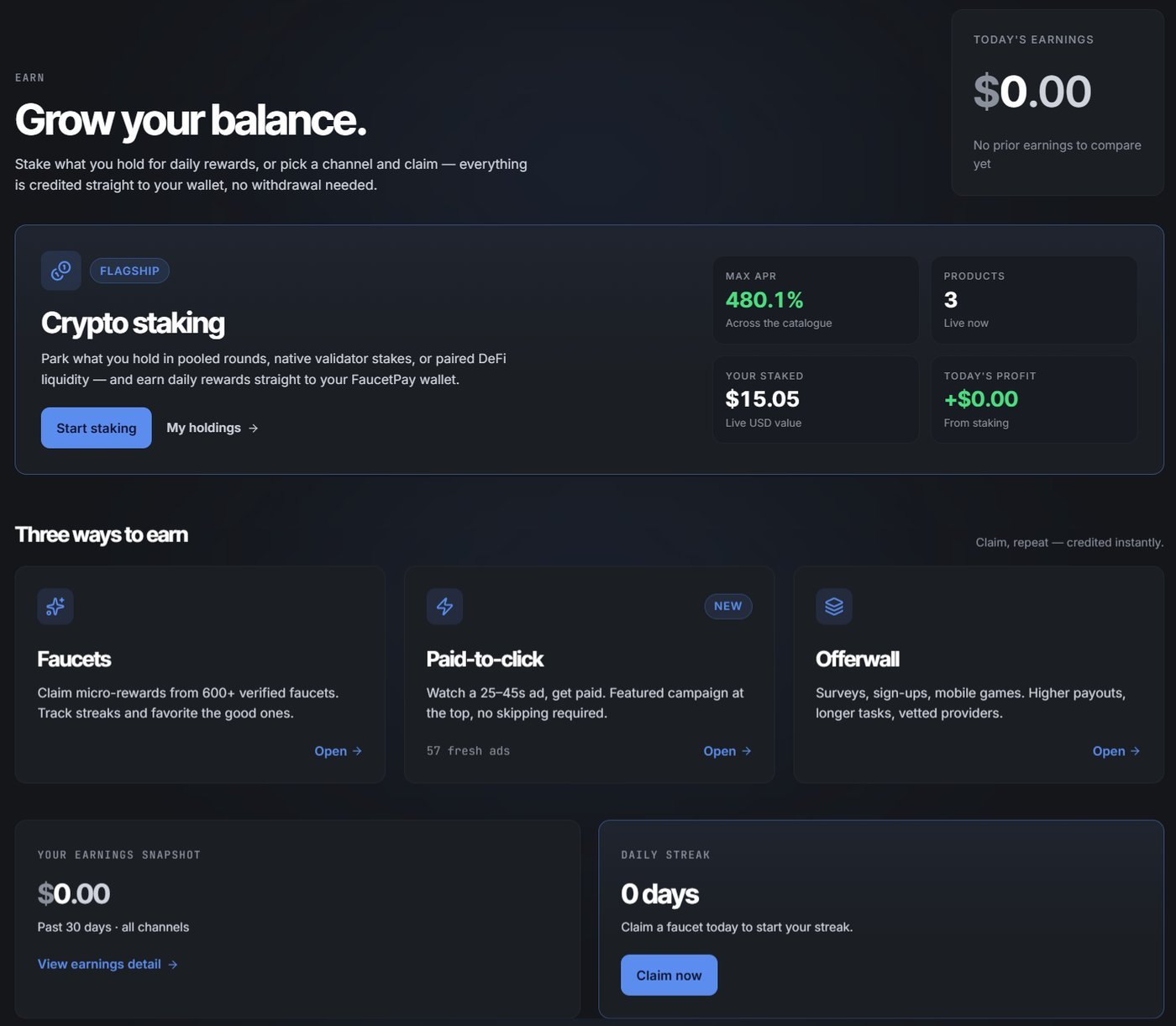
All earning options sit on one page: staking, faucets, paid-to-click ads (PTC) and the offerwall. At the bottom you see a 30-day earnings summary and your daily claim streak. Mine shows $0.00 and 0 days: I don’t claim faucets myself these days; the wallet works as a transit point.
3. Faucet directory

A directory of 600+ faucets with filters by category (faucets, games, PTC and offers, ad networks, apps, mining) and by payout coin. For each faucet you can see how much it paid out in the last 7 days, to how many users, its rating, and a Health column (the faucet’s condition). You can add faucets you like to favorites.
The numbers are sobering. The top BTC faucet paid out about $627 in a week to more than 4,200 users — on average less than 15 cents per person per week. That is the real scale of faucet earnings.
One more detail: above the directory there are sponsored blocks, including binary options and casinos. These are ads, not platform recommendations.
4. PTC — paid to watch ads
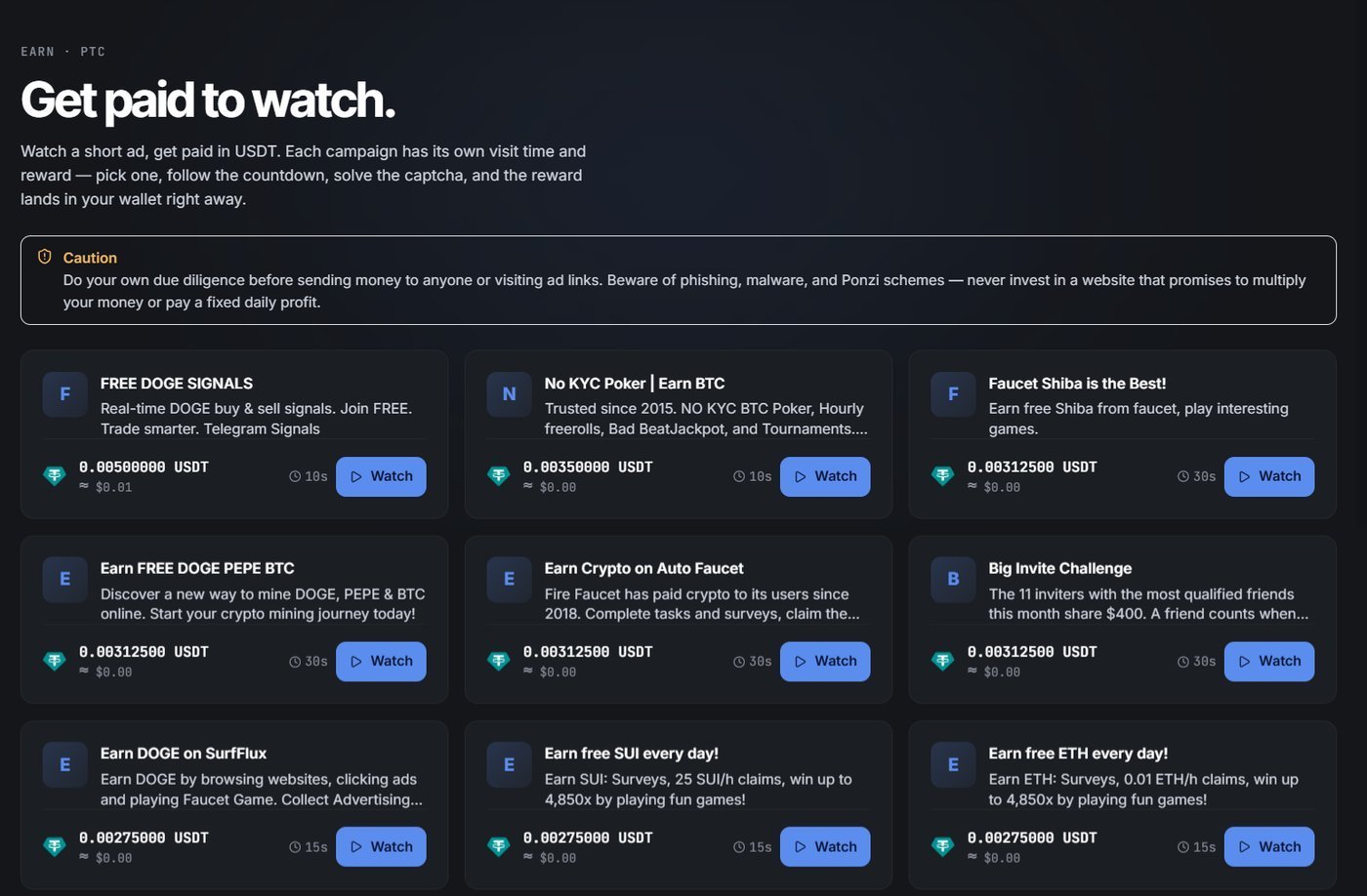
Of all the wallets I know, FaucetPay is the only one where you can earn right inside the wallet by viewing ads. Pick an ad, watch it for 10–30 seconds, solve a captcha — and the USDT reward lands on your balance immediately.
There is a condition: the PTC section unlocks only after you have received payouts from at least five different faucets. That is how the platform filters out bots and empty accounts. So start with faucets and move on to ads later.
Let’s do the math: most ads pay 0.00275 USDT. At the time of the screenshot 57 ads were available — watching all of them would bring about 0.15 USDT. The platform itself warns above the list: never invest in sites that promise to multiply your deposit or pay a fixed daily profit. Many of the advertised projects are exactly that.
5. Offerwall — surveys and tasks

Surveys, sign-ups and tasks from three partners — TimeWall, Monlix and CPX Research. Rewards are paid in internal USDP points, which you can convert to USDT at any time at a fixed rate of 100 USDP = 1 USDT.
Surveys are valued at 25–136 USDP, i.e. 0.25–1.36 USDT, and take 5–19 minutes. On paper this is the best pay inside FaucetPay. In practice, surveys often screen you out after a few questions, and availability depends heavily on your country. My balance shows 3.02 USDP — three cents.
6. Swap
A built-in exchange between coins. Useful for gathering small leftovers into one coin with a cheap withdrawal (for example, LTC, SOL or TON) and withdrawing them as one amount. Judging by my history, that is how I accumulated the USDT and POL I withdrew.
7. Staking and the FEY token

FEY (Feyorra) is the FaucetPay ecosystem’s own token. It is used for staking, swap fee discounts and faucet multipliers. I have 2,863.66 FEY in the Feyorra Pooled product, worth $15.05 at the current rate.
My real numbers: $2.52 profit lifetime, $0.42 over the last 30 days, $1.72 over 170 days. Annualizing $1.72 over 170 days gives roughly 24–25% a year — almost exactly the advertised 23.89% for Feyorra Pooled. So the pool’s yield is honest, but it is paid in FEY: if the token’s price falls, you end up with fewer dollars.
The chart shows that profit doesn’t arrive daily but in spikes — roughly every 55 days, at the end of a round. That is why “today’s profit” almost always shows $0.00, and the active position in the portfolio says “earned 0 FEY”.
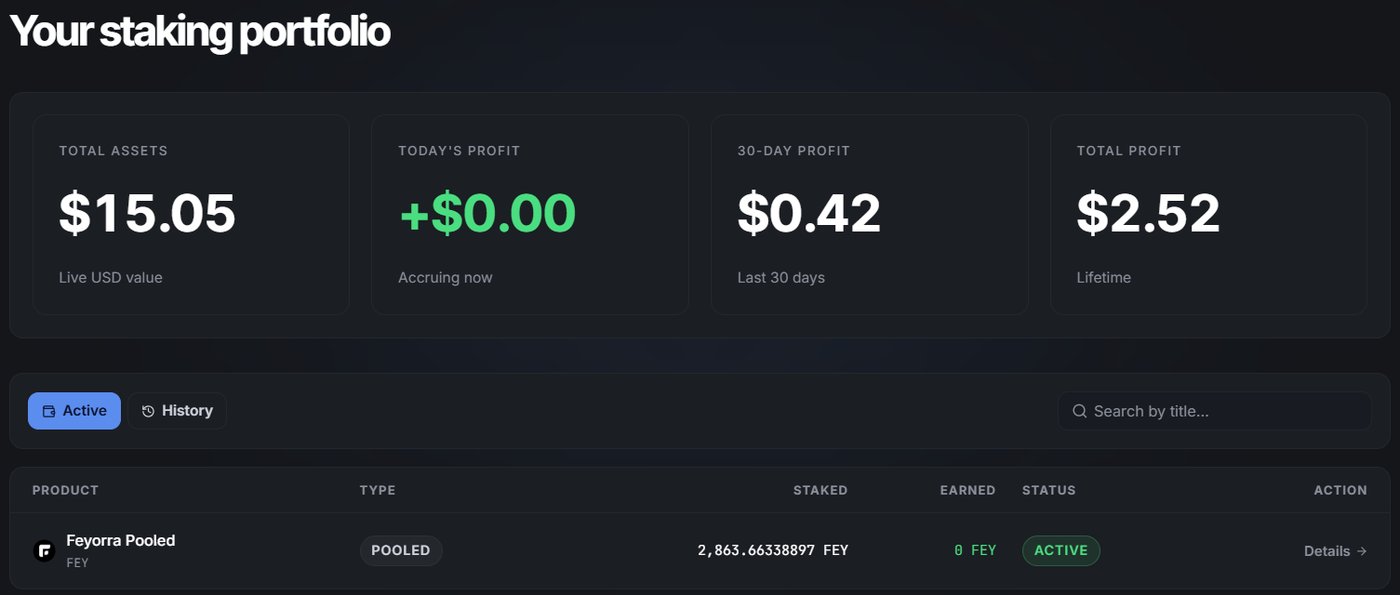

The catalogue currently has three products:
- Feyorra Pooled — 23.89% APR, 55-day lockup, minimum 1 FEY.
- BNB/FEY LP — 290.73%, flexible, minimum 500 FEY.
- TON/FEY LP — 480.10%, flexible, minimum 500 FEY.
My view: an APR in the hundreds of percent on pairs with the platform’s own token is not a guaranteed return. In liquidity pairs you depend on two prices at once, and if FEY falls, the number of tokens grows while their dollar value doesn’t. The figure also moves: on October 20 the top APR in the catalogue was 429.4%, a day later it was 480.1%. The minimum FEY withdrawal is 2,000 FEY, so taking a small FEY balance off the platform isn’t easy.
8. Reward Points and Airdrops
Daily sign-in points (see above) and an airdrops section. Nice extras, but not a source of income.
9. Games, betting and wager mining

The games section now lists 19 titles: Dice, Crash, Plinko, Mines, roulette, slots, blackjack, lottery, and among the new ones — Meme Trade, sports betting and prediction markets. Bets earn FEY (wager mining). Originally the platform advertised 0.07 FEY for every dollar wagered.
This is gambling, 18+. Someone who spent a week collecting satoshi from faucets can lose them in a minute. I don’t recommend this section and don’t use it as a way to earn.
10. Faucet hosting (FaaS) and advertising
New in 2026: you can launch your own faucet for $5 a month on FaucetPay’s hosting. It includes anti-fraud, offerwalls, ad networks and payouts. There is also an ad dashboard for PTC campaigns, banners and sponsored spots in the faucet directory. These are tools for webmasters rather than regular users.
Fees and minimum withdrawals
Deposits and internal transfers are free. Withdrawing to a blockchain costs a fixed platform fee, and each coin has its own minimum. There are two modes: standard and priority (more expensive but faster when the network is busy). Fees are dynamic: the withdrawal window shows the exact amount before you confirm — and, as my history shows, they change over time.
Below is a selection of popular coins from the fees page as of October 20, 2026 (standard mode):
| Coin (network) | Fee | Minimum withdrawal |
|---|---|---|
| Bitcoin (BTC) | 0.00001 BTC | 0.0012 BTC |
| Litecoin (LTC) | 0.00002 LTC | 0.002 LTC |
| Dogecoin (DOGE) | 1 DOGE | 30 DOGE |
| Tron (TRX) | 5 TRX | 20 TRX |
| USDT (BEP-20) | 0.02 USDT | 8 USDT |
| Solana (SOL) | 0.0001 SOL | 0.002 SOL |
| Toncoin (TON) | 0.01 TON | 1 TON |
| Ethereum (ERC-20) | 0.002 ETH | 0.02 ETH |
| Feyorra (BEP-20) | 50 FEY | 2,000 FEY |
What this means in practice:
- The BTC minimum (0.0012 BTC) is almost out of reach for a regular faucet user. It is better to swap BTC inside the platform into a coin with a low threshold.
- LTC, SOL, TON and DOGE are the most convenient options for withdrawing small amounts. My SOL withdrawals cost just 0.0001 SOL.
- USDT can only be withdrawn from 8 USDT — a lot for micro-earnings. Compare fees across networks: on the Tron network I paid up to 4 USDT.
- The TRX fee (5 TRX with a 20 TRX minimum) eats up to a quarter of the amount if you withdraw at the minimum. My last TRX withdrawal in September 2026: 52.92 TRX sent → 47.92 TRX received.
Always double-check the network before withdrawing: FaucetPay does not return funds sent to the wrong network.
Reputation and risks in 2026
Reviews of FaucetPay are mixed. On Trustpilot the service has thousands of reviews and an average rating of around 3.4–3.6 out of 5. Many users praise fast payouts and convenience. But there are recurring complaints:
- Account freezes and bans for “suspicious activity” — sometimes even with 2FA enabled. Reviewers note that complaints about unexplained deactivations grew in 2025–2026.
- Slow support in disputes.
- Hacked accounts whose funds were then lost in games — users report this on Trustpilot.
- High fees on BTC and ETH withdrawals and high minimums for some coins — my own history confirms this.
- Login issues — captcha and session problems have been noted on monitoring services.
That said, I found no reliable evidence that FaucetPay takes user funds on a mass scale. My own experience is 35 withdrawals in 4.5 years without a single refusal. The main complaints concern individual account bans and slow reviews, not the platform disappearing.
How to use FaucetPay safely
- Enable 2FA with an authenticator app and set an anti-phishing phrase: it will appear in every FaucetPay email.
- Use an address whitelist for withdrawals. New addresses activate after 24 hours with email confirmation — protection against an intruder.
- Don’t keep large amounts. Once you reach the minimum, withdraw to an exchange or a personal wallet.
- Check the fee before every withdrawal. If it takes a noticeable share of the amount, swap into another coin.
- Don’t gamble with the satoshi you earned or use games as a way to “multiply” your balance.
- One person — one account. Multiple accounts, VPNs and shady faucets are common reasons for bans.
- Check the login log regularly in your security settings.
- Only use the official address faucetpay.io: the faucet niche has plenty of phishing copies.
How to get started: step by step
- Sign up via faucetpay.io (this is my referral link; your terms don’t change).
- Confirm your email and enable 2FA right away.
- Open Earn → Faucets, choose a coin and a few faucets with good ratings.
- On the faucet site, enter your FaucetPay account email (or an address from Linked addresses).
- Receive payouts from at least five faucets — this unlocks the PTC section.
- Once you have enough, swap small balances into one convenient coin.
- Add your exchange or wallet address to the whitelist, pick the right network, check the fee and withdraw.
Pros and cons
| Pros | Cons |
|---|---|
| Years of operation: 35 withdrawals since 2022 without a refusal in my case | Custodial wallet — the keys aren’t yours |
| Free, instant internal transfers | Withdrawal fees go up and sometimes eat most of the amount |
| 20+ coins and a built-in swap | High minimum withdrawals for BTC, ETH and USDT |
| Faucets, PTC and offerwall in one place | Complaints about account freezes and slow support |
| Good security tools (2FA, whitelist, login log) | Gambling and betting right inside the wallet |
| Activity bonuses (RP, airdrops) | Staking returns depend on the price of its own FEY token |
Who FaucetPay is for — and who it isn’t for
A good fit for anyone who collects small payouts from faucets, PTC sites and offerwalls and wants to withdraw them as one amount. Also for those who want to learn, without investing, how crypto wallets, networks and fees work.
Not a fit for anyone looking for a safe place to store crypto, a steady income or “passive income from staking”. For storage, a reputable exchange or a non-custodial wallet is better; for transfers, classic payment services.
Verdict: my rating
FaucetPay is still the key tool in the crypto faucet niche, and many faucets simply don’t work without it. My experience over 4.5 years: 35 withdrawals, all arrived. But over these years the platform has grown from a simple microwallet into an all-in-one service with games, betting and staking of its own token, and withdrawal fees have risen noticeably. The useful core — free internal transfers and gathering small change in one place — is still there. Everything else calls for caution.
VIN rating: 3.5 out of 5. Use it as a transit wallet: turn on protection, withdraw regularly, check fees, don’t gamble and don’t store money there.
Frequently asked questions
Is FaucetPay a scam?
No, it is a working service with a long payout history. I have made 35 withdrawals since February 2022, all marked “Completed”. But it has risks: account freezes, slow support and a custodial model. Don’t keep more there than you are ready to lose.
Can you earn on FaucetPay without investing?
Yes, through faucets, PTC, the offerwall and reward points. But income is measured in cents and a few dollars. For example, all 57 available PTC ads together are worth about 0.15 USDT, and my 8 referrals earned me $2.49 in total.
How long does a withdrawal take?
In my history, usually from a few seconds to 7 minutes. BTC withdrawals in 2023 took longer, up to 2.5 hours.
What is the FaucetPay minimum withdrawal?
It depends on the coin: for example, 0.002 LTC, 30 DOGE, 1 TON or 8 USDT (BEP-20). The current table is on faucetpay.io/fees.
What is FEY?
The FaucetPay ecosystem’s own token. It is staked, earned from game bets and used for fee discounts. My real return in the Feyorra Pooled product is about 24–25% a year in FEY, but keep in mind that FEY’s price can fall.
Is verification (KYC) required?
Not to get started — an email is enough. But the platform may request verification in case of suspicious activity or large withdrawals.
Can I withdraw to a bank card?
No, withdrawals are crypto only. Withdraw to an exchange first, then convert to fiat there.
Read also
- SimCash.io review: 2 years of real payouts and SIM card risks
- Paysend review: transfers, fees and referral rewards
- Godl.de review: a German ad network to earn and advertise
- Veles Finance review: crypto trading bots on Binance
This article contains a referral link: if you sign up through it, I receive a small share of the platform’s activity, and your terms don’t change. This material is for information only and is not investment advice. Fee data is current as of October 20, 2026; transaction history as of October 21, 2026.