
VIN • Exchange Trading • Trading Bots • Updated 7 November 2026
Veles Finance is a cloud trading-bot service: it connects to an exchange via an API key and trades for you around the clock. I’ve used it since January 2024 — first on personal accounts across five exchanges, and since September 2026 on the corporate account of Virtual Income Network OÜ on Binance. This article shows my numbers for the whole period: how much the bots earned, when they make money and when they don’t, and the mistakes I made.
In short
- From January 2024 to November 2026 my Veles bots earned about 1,520 USDT gross — before the Veles fee.
- Most of the profit came in the volatile end of 2024. In the calmer market of 2025–2026 the bots mostly brought 1 to 25 USDT a month per exchange.
- Gross only counts closed trades. Open positions in the red don’t show up in it — and that’s the main risk.
- Corporate account on Binance, September–October 2026: +40.30 USDC, with not a single sale at a loss.
- Veles takes 20% of the profit on closed trades, capped at $50 a month per trading type. The bots themselves are free.
What Veles Finance is
Veles is a platform that runs trading bots on your exchange account. The money stays on the exchange; Veles only sends orders. The service includes:
- DCA bots and grids — they buy in parts as the price falls and sell as it rises.
- Backtests — testing settings on past data.
- A trading terminal and a strategy marketplace.
- A mobile app.
- Veles Broker — trading without connecting API keys.
Veles works with Binance, Bybit, OKX, Gate, HTX, BingX, Bitget, Hyperliquid and other exchanges — the list depends on your region.
Security
The API key lets Veles trade but not withdraw money. To protect yourself, disable withdrawals when creating the key, restrict it to Veles IP addresses, and turn on two-factor authentication both on the exchange and in Veles.
Pricing
- Bots, the terminal and basic backtests are free.
- The service fee is 20% of the profit on closed profitable trades, capped at $50 a month per trading type.
- Advanced backtests come with separate PRO plans.
- Exchange fees are paid to the exchange separately.
The Veles fee is debited from an internal balance that you top up in advance. If the balance runs out, the bots stop.
My results: 27 months on five exchanges
Veles statistics can be filtered by exchange. Here’s what my personal accounts show from 1 August 2024 to 6 November 2026:
| Exchange | Gross, USDT | Trades | Bots |
|---|---|---|---|
| Bybit Spot | 815.61 | 5399 | 406 |
| Bybit Futures | 238.69 | 484 | 62 |
| BingX Futures | 140.58 | 258 | 20 |
| Gate Spot | 97.79 | 1114 | 58 |
| HTX Spot | 81.09 | 328 | 13 |
| Total | 1373.76 | 7583 | 559 |
Including January–July 2024, for which I don’t have a breakdown by exchange, the total is 1,519.56 USDT gross. Gross is the profit on closed trades before the Veles fee; exchange fees are a small share on the Veles chart.
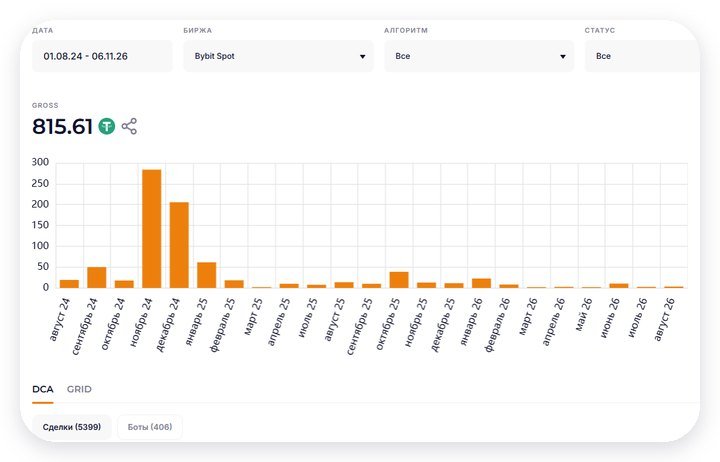
When bots make money and when they don’t
Look at the monthly chart. On Bybit Spot, November and December 2024 brought about 490 of the 815 USDT. On Bybit Futures, about 180 of 239 USDT came in August–September 2024. Since spring 2025, almost every month on every exchange has been single digits or a couple of dozen dollars.
The conclusion is simple: DCA bots earn on volatility and rising markets. In a prolonged decline or a sideways market they bring almost nothing, while capital stays tied up in open positions.
The experiment: 200+ bots on €1,000
In November 2024 I decided to test what happens if you launch lots of bots at once. On Bybit, with about €1,000 of capital, I opened more than 200 bots. While the market was rising everything worked great — my record was about $40 of profit in a single day. But when the market dropped sharply, the bots ran out of money: all free funds went into additional buys, and the grids stopped halfway.
The main lesson: more bots doesn’t mean more profit. Every bot needs a reserve for its entire grid of buys.
Futures: a position that’s stuck
On my personal accounts I also tried bots on futures — on Bybit and BingX. Here’s an honest example: a bot on BingX Futures for NFLX/USDT (a perpetual contract on Netflix shares). From late August to late October 2026 the price kept falling, and the bot filled 10 of its 15 additional buys. The position is about 87 USDT at an average price of 70.78, and the price on 6 November is 63.54. That’s about 10% in the red, roughly −9 USDT.
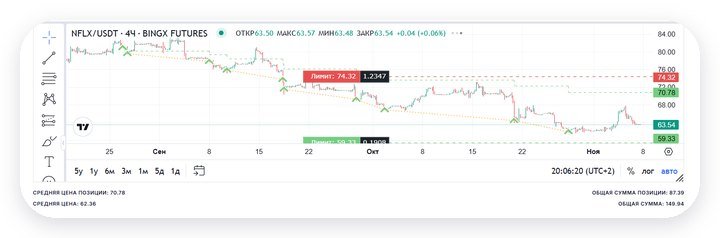
This loss doesn’t appear in the gross statistics — they only include closed trades. So whenever you see impressive profit figures for any bot, ask how much money is currently frozen in open positions. Situations like this are exactly why I trade only spot, without leverage, on the corporate account.
Corporate account on Binance: September–October 2026
Since 4 September 2026 Veles bots have been running on the corporate account of Virtual Income Network OÜ on Binance — spot long bots on USDC pairs. Results for the first two months:
- realised profit — +40.30 USDC: September 18.56, October 21.75;
- after exchange fees — about 37.6 USDC;
- 21 trading pairs, 41 closed trades, zero sales at a loss;
- in October there was profit on 13 of 31 days; the best day was 10 October, +4.42 USDC;
- the biggest earners were ICP (4.99), STRK (4.98), LINK (4.74), ARB (4.28) and WLD (4.14).
A successful trade: WLD fell about 20% in four days, the bot made 11 buys for 129.86 USDC at an average price of 0.5219 and sold everything at 0.5375. Result: +3.87 USDC in 5 days and 9 hours.
The flip side: at the end of October about 529 USDC was in open positions at purchase price, and after the market fell some of them are worth less. The account value on 31 October was about €424. Details and account screenshots are in my Binance review.
My current strategy
On the corporate account it’s spot and long only, with no leverage. The bot makes a first buy of about 9 USDC, then places a ladder of 20 limit orders. The lowest rung is about 40% below the first buy. When the price rises about 3% above the average price, a trailing stop sells the whole position.
My rules after two years with bots
- No more than 30% of capital in positions. The rest is a reserve for additional buys. While the capital is small, this is a goal rather than reality.
- Don’t sell at a loss. If the market falls, the bot waits, and I add capital or temporarily stop launching new bots.
- More bots doesn’t mean more profit. I tested that with 200+ bots.
- No leverage. A losing futures position can end in liquidation; a spot position simply waits.
- Withdraw profit regularly and check the bots once a week.
Pros and cons
Pros
- Fees only on profit, with a monthly cap.
- Veles can’t withdraw your money — the key has no withdrawal rights.
- Works with most major exchanges.
- Backtests, a terminal and a mobile app.
Cons
- In prolonged declines and sideways markets the bots earn almost nothing.
- You need free capital for additional buys, and it can be frozen for months.
- A backtest doesn’t guarantee results.
- Gross statistics don’t show losses on open positions.
Who Veles suits
People who already trade on an exchange and want to take emotion out of their trades; who are willing to spend time on setup; and who have money they can leave working for a long time. If you’re expecting a stable monthly income, bots won’t provide it: the result depends on the market.
The Veles partner programme
Veles has a partner programme: partners receive part of the service fee from users they refer. The Veles fee for the referred user doesn’t change. If you run a trading website or channel, you can get a link in your Veles account.
FAQ
Can Veles withdraw my money?
No, if you created the API key without withdrawal rights. The money stays on the exchange; Veles only places orders.
How much money do you need to start?
A few dozen dollars is enough for one bot. My 20-rung grid needs about 300 USDC per bot to cover all the additional buys.
How much can you earn with Veles?
For me — about 1,520 USDT gross over 34 months on several exchanges, but unevenly: dozens or hundreds of dollars in volatile months, single digits in calm ones. There’s no guaranteed income.
Do you need to watch the bots all the time?
Checking once a week is enough, plus making sure the internal Veles balance has enough to cover the fee.
Does Veles guarantee profit?
No. Veles is a tool. The result depends on the market, the coins and the settings.
Conclusion
Veles is a working tool, not a promise of income. Over almost three years my bots brought about 1,520 USDT gross, but most of it came in one good period, and open positions in drawdown don’t show up in the nice-looking statistics. If you treat bots as a long-term experiment — spot, with a reserve and no leverage — they can earn on volatility. I publish updates on the corporate account every month.
The “Veles Finance” buttons are my partner link: if you sign up through it, I may receive part of the Veles fee; your terms don’t change. Statistics come from my Veles accounts and exchange exports as of 6 November 2026; figures read from charts are rounded. Past results don’t guarantee future results. Crypto trading, especially with leverage, can result in the loss of invested funds.
Information is current as of 7 November 2026. This material is for information only and is not investment advice.

