VIN • Earn Without Investment • Apps · Updated 25 October 2026
Pi Network is a mobile crypto project that rewards you with coins for starting a mining session in its app once a day. I have been mining Pi for several years: I quit twice and came back twice. This review is not a retelling of the marketing — it is the real numbers from my own account as of October 2026, an honest conversion into dollars, and what has changed in the network over the last few weeks.
Join Pi Network (invite code: lessonz)
My account: what Pi shows in October 2026
Below is the balance breakdown from the “Mainnet balance preview” screen of my app on 25 October 2026 (my app interface is partly in Russian).
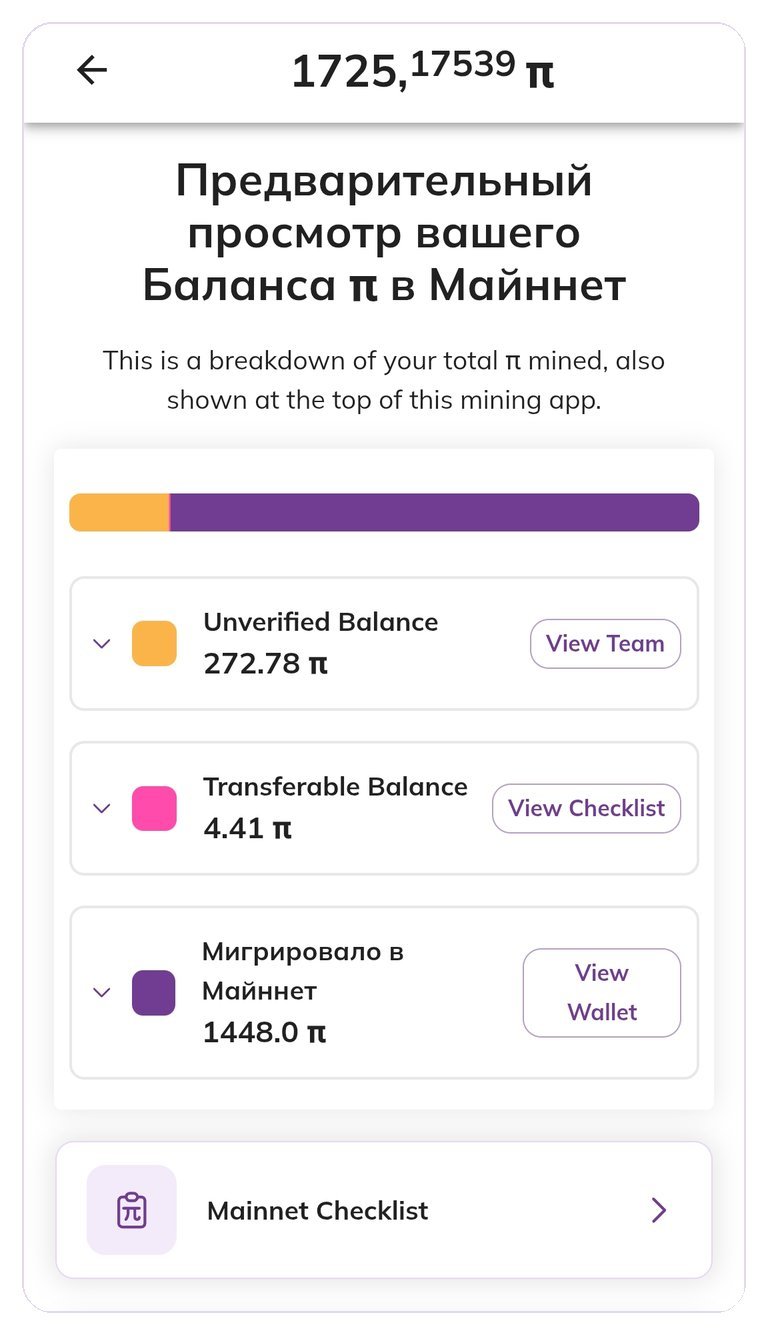
| Balance part | Amount | What it means |
|---|---|---|
| Migrated to Mainnet | 1,448.0 π | Already in my Pi Wallet on the blockchain. These are real coins I can use (subject to the lockup I chose). |
| Transferable Balance | 4.41 π | Mined since the last migration. My KYC is done, so these coins will move to the wallet in the next migration wave. |
| Unverified Balance | 272.78 π | Bonuses from referrals who have not passed KYC themselves. Until they verify, this part stays frozen. |
| Total in the app | 1,725.18 π | The number shown at the top of the main screen. |
The main screen also shows the mining parameters:

- Mining rate: 0.010 π/h — about 0.24 π per day and roughly 7 π per month.
- Security Circle: 100% complete.
- Lockup Boost: 78.69% — my coins are locked for a period, and in return my rate is higher.
- Referral Team: 0 of 11 active. The people I invited long ago stopped mining, so my team bonus is currently zero.
What it is worth in money — an honest calculation
Pi has been trading on exchanges since February 2025. Its all-time high was about $2.99, but in October 2026 the price fell below $0.08. At $0.0786 (23 October 2026):
| Full balance, 1,725 π | ≈ $136 |
| Mainnet only, 1,448 π | ≈ $114 |
| One month of mining (≈ 7 π) | ≈ $0.57 |
The conclusion is simple: most of my account’s value was built in the early years, when the mining rate was many times higher. A new member today starts at a much lower rate, and at the current price a month of daily taps brings in cents. That is why I don’t call Pi “earning” — it is more like a free lottery ticket with a very long wait.
What’s new in Pi Network: October 2026
- Protocol 28 on Mainnet. Node operators were asked to upgrade to version 28 by 13 October, and the network switch was scheduled for 16 October. As of 25 October the Pi Node page still shows a “Protocol upgrades in progress” banner, so the process is not officially closed yet. Regular phone miners are not affected.
- Pi Desktop 0.6.4 and SoloHost (23 October). The new desktop release makes remote access to SoloHost apps easier — apps such as local AI agents that run on your computer and open on your phone via Pi Browser. No more router configuration.
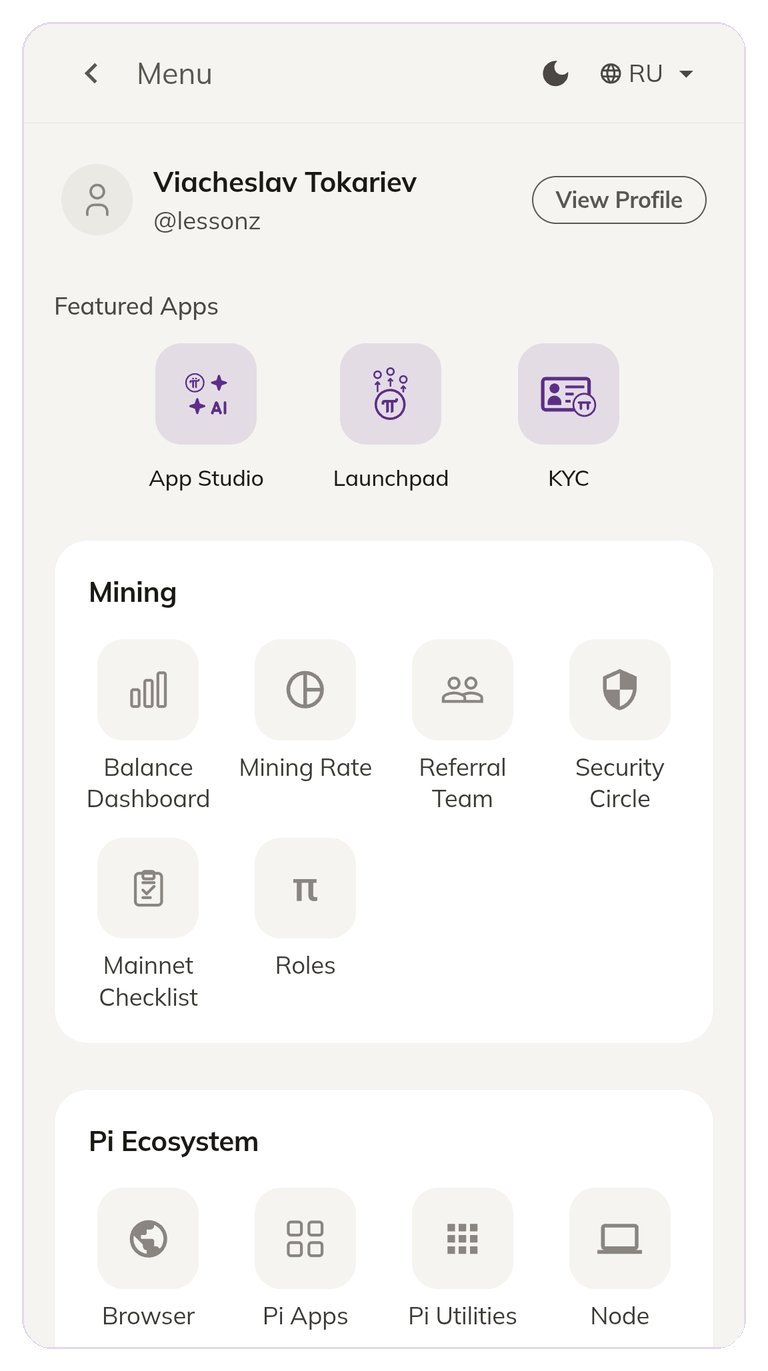
- App Studio and Launchpad. The app menu now has dedicated sections: App Studio (building apps with AI) and Launchpad. Pi is clearly shifting its focus from “mining” to an app ecosystem.
- Stablecoins. Pi announced a partnership with Open Standard, the team behind the OUSD stablecoin. For now it is about exploring options; nothing has launched.
- KYC. According to crypto media, more than 417,000 accounts previously flagged as possible duplicates can now continue verification.
- Ecosystem Summit, 17–19 November 2026. Pi’s first online event for developers and the ecosystem.
How Pi mining works
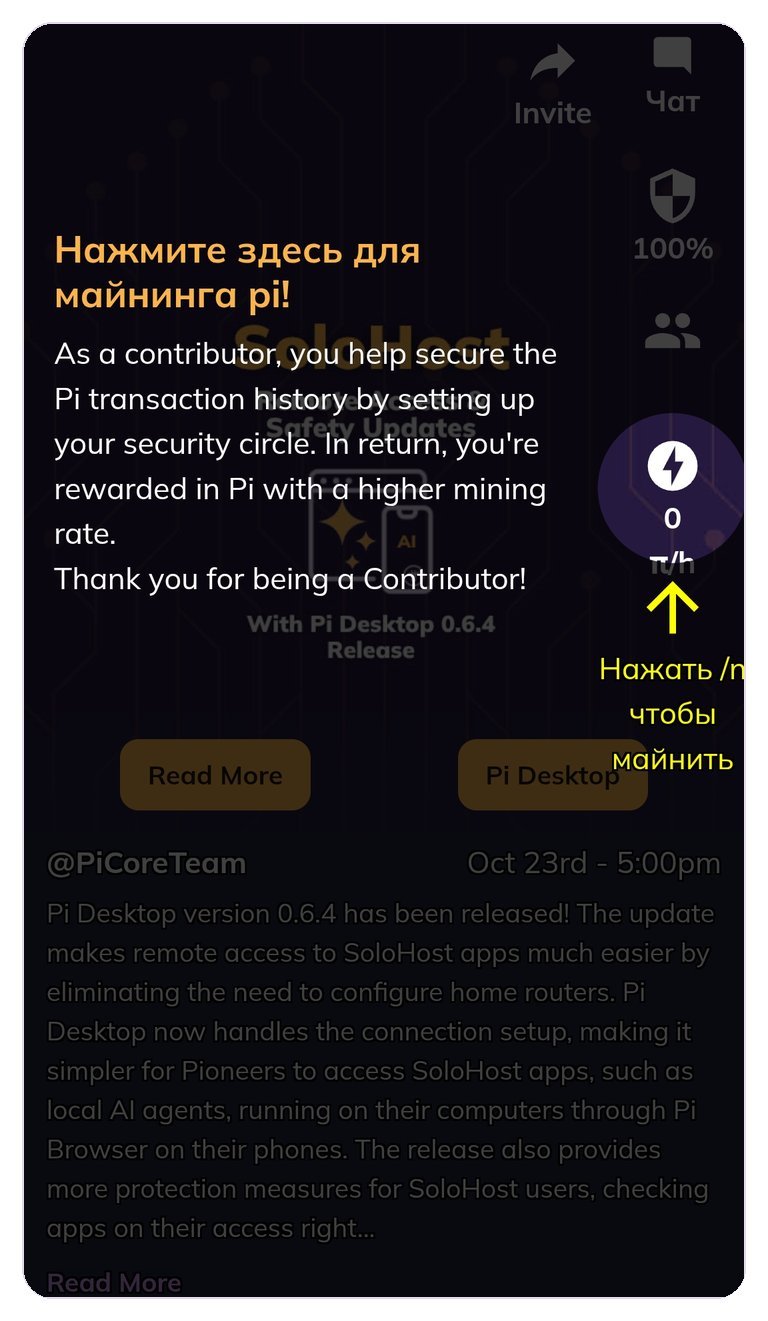
The mechanics haven’t changed: you open the app and tap the lightning button to start a 24-hour session. You don’t need to keep the app open, and it doesn’t drain your battery. After 24 hours you start the next session.
| Element | How it works | Practical meaning |
|---|---|---|
| Daily session | Start mining once every 24 hours | Miss it — no rewards that day |
| Security Circle | 3–5 trusted members | Raises your rate at no cost |
| Referral Team | Bonus from active invitees | Inactive referrals give zero — proven by my 0/11 team |
| Lockup | Locking part of your coins for a period | Raises your rate, but the coins are unavailable until the term ends |
| KYC and migration | Identity check and Mainnet checklist | Without them your app balance stays just a number |
| Pi Wallet | Non-custodial wallet in Pi Browser | Lose your passphrase — lose your coins |
How to raise your rate: what works in practice
1. Never skip a session
This is the foundation. Turn on the reminder in the app and you’re set.
2. Complete your Security Circle
Mine is 100% complete. Only add people you know personally who actually use Pi.
3. Only an active team counts
My experience: 11 people invited years ago means 0 active today. You only get a bonus for those mining right now. On top of that, their unverified coins get stuck in your Unverified Balance. Two interested people are better than twenty random sign-ups.
4. Use lockup deliberately
Lockup gives me +78.69% to my rate, but the coins are locked. At today’s price it only makes sense if you weren’t planning to sell anyway.
5. Apps in Pi Browser
The ecosystem is growing: App Studio, Launchpad, hundreds of apps on Mainnet. How much they are actually used is still an open question.
6. Node — for advanced users
A node runs only on a computer, needs regular upgrades (as now with Protocol 28) and isn’t for everyone.

Risks and limitations
- The price has fallen more than 95% from its all-time high — there is no guarantee of growth.
- One person — one account; mining from multiple devices is not allowed.
- Without KYC and migration your balance does not become real coins.
- The Pi Wallet passphrase cannot be recovered. Enter it only in the official wallet — never on third-party sites or for “support” in messengers.
- Part of your balance can sit in Unverified for years if your referrals don’t pass KYC.
- Migrations happen in waves, not instantly.
Who Pi Network is for
A good fit
- people willing to spend 10 seconds a day without expecting quick money;
- people ready to pass KYC and learn how the wallet works;
- people interested in the Pi ecosystem as an experiment.
Not the best choice
- people looking for noticeable income this year;
- people hoping to earn from invitations — without an active team it doesn’t work;
- people not ready to safely store a passphrase.
Pros
- free to join, no investment needed;
- real coins on Mainnet — I already have 1,448 π in my wallet;
- the network keeps developing: protocols, nodes, apps.
Cons
- new members mine very slowly;
- price below $0.08 — a month’s result is measured in cents;
- a complicated path to real coins (KYC, checklist, migration).
How to start: a plan for beginners
- Sign up and turn on the session reminder.
- Build your Security Circle from people you actually know.
- Create your Pi Wallet and write the passphrase down on paper.
- Complete KYC and the Mainnet Checklist as early as possible.
- Review your results after 2–3 months soberly, by the numbers, not by promises in chats.
Try Pi Network (invite code: lessonz)
Pi Network FAQ
Do I need to keep the app open?
No. Once you start a session you can close the app — mining continues for 24 hours.
How much can you mine in 2026?
Not much. My rate with a full Security Circle and lockup is 0.010 π/h, about 7 π per month. That’s less than a dollar at the current price.
What is the Unverified Balance?
Bonuses from referrals who haven’t passed KYC. They become transferable only once those people verify.
When does Pi become transferable?
After your KYC, the Mainnet Checklist and migration to Pi Wallet. Coins mined later move in subsequent waves.
Does the Protocol 28 upgrade affect me?
Only if you run a node on a computer. Phone mining continues as usual.
Is it worth starting now?
If you see Pi as a free long-term experiment — yes. As a source of income — no.
Conclusion
Over several years Pi has given me 1,725 π, of which 1,448 π are real coins on Mainnet, worth about $114 at the late-October 2026 price. That is an honest result: not zero, but not the “wealth” promised in chats either. The project is alive — it upgrades its protocol, ships Pi Desktop, builds App Studio and is preparing an Ecosystem Summit. But for a new member, mining today means cents per month and a long wait.
My approach: I keep tapping the button once a day, keep my coins in lockup and don’t expect more from Pi than it actually delivers.
The PI price is based on crypto media data as of 23 October 2026 and changes quickly. This article is for information only and is not investment advice. The Pi Network link is a referral link.